Cohort 01 · Aventura · February to July 2027
A six-month program for adults deciding what comes next.
Twenty-four Tuesday evenings in Aventura: eighteen people, and a mentor of your own. You write down where you want to be in two years, then spend thirteen weeks building the first real piece of it — alongside a team that notices when you go quiet. Not therapy, and not a course you watch: a room, a method, and something finished on the table in July.
Cohort 01 is taught in Hebrew. The first English-language cohort will be Cohort 02.

Who it is for
You are not the only one.
- You know something has to change, but not exactly what.
- Your days have filled up with work and screens, and you rarely meet anyone new anymore.
- You have started things on your own before — a plan, a routine, a project — and watched them fade.
- You want people around you who are building something too.
Most people in that place think it is just them. It is not. Northbound is a room of eighteen adults at the same point in life, working it out together — with a method, a mentor and a date to finish by.
What you get
Five things that are hard to get on your own.
Clarity about what you want
You start by writing where you want to be in two years, across six parts of your life. For most people it is the first time it has all been on one page — and specific enough to act on.
A room of people, every Tuesday
The same eighteen faces every week for six months. If your social life has quietly thinned out — for whatever reason — this is a standing table you do not have to organize.
The push you do not get alone
Working on yourself is like the gym: easy to plan, hard to keep doing by yourself. Here your mentor follows your progress, and every week your team expects your line in the Ledger.
A path, in the right order
First you find out where you stand. Then you write the page, learn the tools, and build — in that order, so each step has what it needs. In July you are further along, with something finished to show for it.
Real experience in a team
Your team of six gets a real brief, a budget and a deadline. You hand out roles, decide together, plan before you act, and deliver your piece on time — what it takes to build or run anything bigger than yourself.
How it works
Four things to work with, and one line a week.
- The page
- One page, present tense, two years out by default, across six areas of your life — health, relationships, money, work, growth and what you give back. It opens with what you have already been given. The page stays private. Your mentor never reads it; one line of it — the intention you choose to share — goes to them, and they follow it with you. The school sees one of the six sections, Career & Vocation, because that is where your First Move comes from, and every time it is opened is recorded.
- The First Move
- From one line of that page you draft a single thing you can finish in thirteen weeks — about two hours a week on top of Tuesday nights. Your mentor sizes it down to fit; this is not a second job. At graduation it has to be on the table — a thing that exists, not a tally of attempts. Beside it you build The File: five documents, the same five for everyone, each one the output of a named session. If the thing itself goes sideways because the world said no, the File still exists and the work was real.
- The Legacy
- Three teams of six, the same teams for the whole program. At session eleven Nadav gives each team its commission: build something real for Northbound itself — a written brief, a deadline, a $400 budget — and present it at graduation. The commission is the occasion; the point is the five other people: how a group decides, who carries what, what it is like to owe someone your piece by Tuesday.
- The mentors
- Six volunteer mentors, three students each. Yours is your accountability partner for the six months — a one-on-one coffee, two Zoom calls and two phone calls — and follows your First Move. They never read your page.
The LedgerOne written commitment a week, reported to your team. Nothing is handed in or graded.
The evening
Two and a half hours, the same shape every week until session eleven.
Why it works
Built on what has been measured.
One finding shaped the design more than any other: imagining your best future lifts your mood — and on its own, the lift is gone within about a week. So at Northbound the page is never the end. It is followed by a project, a weekly commitment reported to your team, and a mentor. A few more of the findings behind it, in plain words:
Heekerens & Eid, 2021. Meta-analysis of 34 trials: the effect is strongest right after, with no lasting effect on its own.
People who joined a weight-loss program with friends, and learned how to back each other up, were nearly three times as likely to keep all the weight off: 66% against 24%.
Wing & Jeffery, 1999. 166 adults. The two groups compared are the extremes: joined with friends plus support training, against joined alone with standard treatment. Weight loss, not life goals — the principle carries over, the exact numbers may not.Minutes a day Americans spent with friends in person — in 2003, and then in 2020.
U.S. Surgeon General’s advisory on loneliness, 2023, from the American Time Use Survey. 2020 was a pandemic year.Roughly how long it takes to turn a stranger into a casual friend. Twenty-four evenings is sixty hours in the same room.
Hall, 2019. Surveys of adults who had just moved and of new students. The hours were self-estimated. A close friendship takes far longer — the rest happens between Tuesdays.“When X happens, I will do Y.” Writing a plan in that form raised follow-through across 94 studies. People who wrote down the day and time of their flu shot got vaccinated more often; writing only the day made no clear difference.
Gollwitzer & Sheeran, 2006 (94 studies, 8,461 people); Milkman and colleagues, 2011. It works on top of a goal you already want — it does not create one.Keeping track of your progress helps you reach a goal — and helps more when it is written down or reported to someone. That is what your weekly Ledger line to your team, and your mentor’s one-on-ones, are for.
Harkin and colleagues, 2016. Meta-analysis, 19,951 people. Reporting your progress to a few people — not announcing your goals to everyone.Lectures about teamwork made no measurable difference to how people worked in teams. Practicing it — workshops, simulations, reviewing what went well — did.
McEwan and colleagues, 2017. 72 controlled studies, 8,439 people, mostly in healthcare, aviation and the military.The six months
The order is the design.
Nothing is asked of you before you have the tool for it. By the night you commit, you have already written the page, practiced reading it, and found out what gets in your way.
Where you stand
The beliefs you did not choose, the purpose sentence, the cost of waiting, and the plan for the day motivation is gone.
The page
What you have been telling yourself, and then the page itself — written, not discussed.
The mechanics
Attention, obstacles, emotion, interference: how the page actually works, before anyone relies on it.
The work begins
You draft your own project, your team takes its commission, and everything gets broken into pieces with dates on them.
Execution
Starting, ideas, money, hours, sequence, tools, specialization. Eight weeks of doing it rather than planning it.
Sending you out
The ask, and the version of the page you keep — written by hand, and dated.
What you leave with
On the table
- One finished thing, with thirteen weeks of recorded evidence behind it.
- A page you actually believe, because you wrote it three times and cut whatever you were only saying.
- Twenty-four methods, each practiced on your own material — and the ones that matter used again weeks later.
And after
- Five people trained in how to support you, who know your work by now.
- A mentor who watched you do the work, not just a record that you turned up.
- A small bound book: a Certificate of Completion on the first page, and your final page written into it in your own hand.
What it is not
Worth knowing before you apply.
The mentors are not clinicians, and the evenings are not about going back over the past. They are about what you build next.
Every method is practiced in the room, on your own material, the night it is taught. You come for the room as much as the lecture.
Northbound is not accredited and does not award a degree. What you leave with is the finished thing, the people, and a mentor who watched you do it.
If you need support with your mental health, a therapist or doctor is the right place to start — Northbound works best alongside that, not instead of it. And results are not guaranteed: what you get depends on the work you put in.
Who runs this
Why Northbound exists.
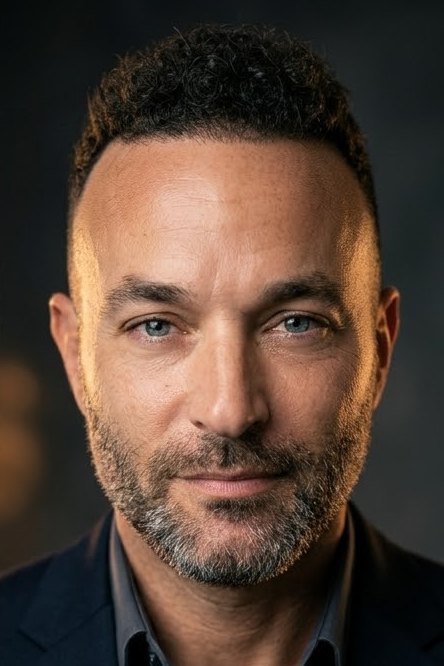
Nadav Dvir builds businesses. In Israel, at the age of twenty-four, he was managing the branches of a gelato and coffee chain of more than forty. In 2014 he moved to Sunny Isles Beach, and has since built several companies in vacation rentals across South Florida.
Through all of it, for twenty years, he has read almost nothing but self-development — and put much of it into practice. Read enough and a pattern appears: authors who disagree on almost everything agree on a small number of things. Northbound’s curriculum is built from that common ground, put in the order you need it, with each idea checked against the research before it reaches the room.
Three of those ideas he had already lived: writing down who you intend to become; a MasterMind of eight people who met every month for almost two years, and left with a business partnership and lasting friendships; and contribution — which is why the six mentors here are volunteers. Northbound puts them in one room, and adds a shared aim.
Nadav Dvir · Founder
The practical part
What it asks of you.
Northbound Academy is open to all adults aged 18 and over. We do not discriminate on the basis of race, colour, religion, ancestry, national origin (including citizenship, place of birth or language background), age, sex, pregnancy, disability, marital status, family status, sexual orientation, gender identity or gender expression, or status as a victim of domestic violence, dating violence or stalking, in admissions, pricing or any part of the program. Cohort 01 is taught in Hebrew and Cohort 02 in English; anyone who can take part in the language of their cohort is welcome to apply. If you need an accommodation because of a disability, tell us at any stage and we will work with you.
Questions
What people ask first.
Do I need to speak Hebrew?
For Cohort 01, yes — every evening is taught in Hebrew. If you would rather do it in English, apply anyway and say so in the form. Cohort 02 will be the first English-language cohort.
How much time does it take?
Tuesday evenings from 7:30 to 10:00 PM, and once your First Move begins, about two hours a week on it. Your mentor sizes the project to fit your life; it is not a second job.
What if I miss an evening?
To graduate you need 21 of the 24 sessions. Three evenings — sessions 6, 11 and 24 — and graduation cannot be missed. A missed session is made up within two weeks, and then it counts as attended.
What happens after I apply?
One of the mentors calls you within two days. The call takes about fifteen minutes and there is nothing to prepare. At the end, the mentor goes over the cost, so nothing comes as a surprise later. If it looks like a fit on both sides, you then meet Nadav for a 30-minute conversation. Places are offered only after that.
What does it cost?
$1,250 — a $250 deposit and four monthly payments of $250. Paid in full up front, it is $1,150.
Who is it for?
Adults, 18 and up, at a point where something has to change — work, direction, what the next two years are for — who have decided to do something about it.
Will my mentor read what I write?
No. Your page stays private. One line of it — the intention you choose to share — goes to your mentor, who follows it with you over a coffee, two Zoom calls and two phone calls across the six months.
Applying
It starts with a conversation, not a form.
Tell us how to reach you. A mentor calls you for fifteen minutes — and if it looks like a fit, you then meet Nadav for a 30-minute conversation.
Northbound Academy is open to all adults aged 18 and over. We do not discriminate on the basis of race, colour, religion, ancestry, national origin (including citizenship, place of birth or language background), age, sex, pregnancy, disability, marital status, family status, sexual orientation, gender identity or gender expression, or status as a victim of domestic violence, dating violence or stalking, in admissions, pricing or any part of the program. Cohort 01 is taught in Hebrew and Cohort 02 in English; anyone who can take part in the language of their cohort is welcome to apply. If you need an accommodation because of a disability, tell us at any stage and we will work with you.
That did not send. Please email us and we will take it from there: [email protected]
Thank you. One of the mentors will call you within two days for a short conversation — about fifteen minutes, no obligation, and nothing to prepare.